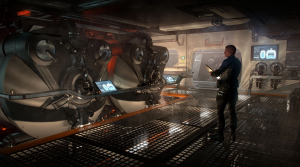
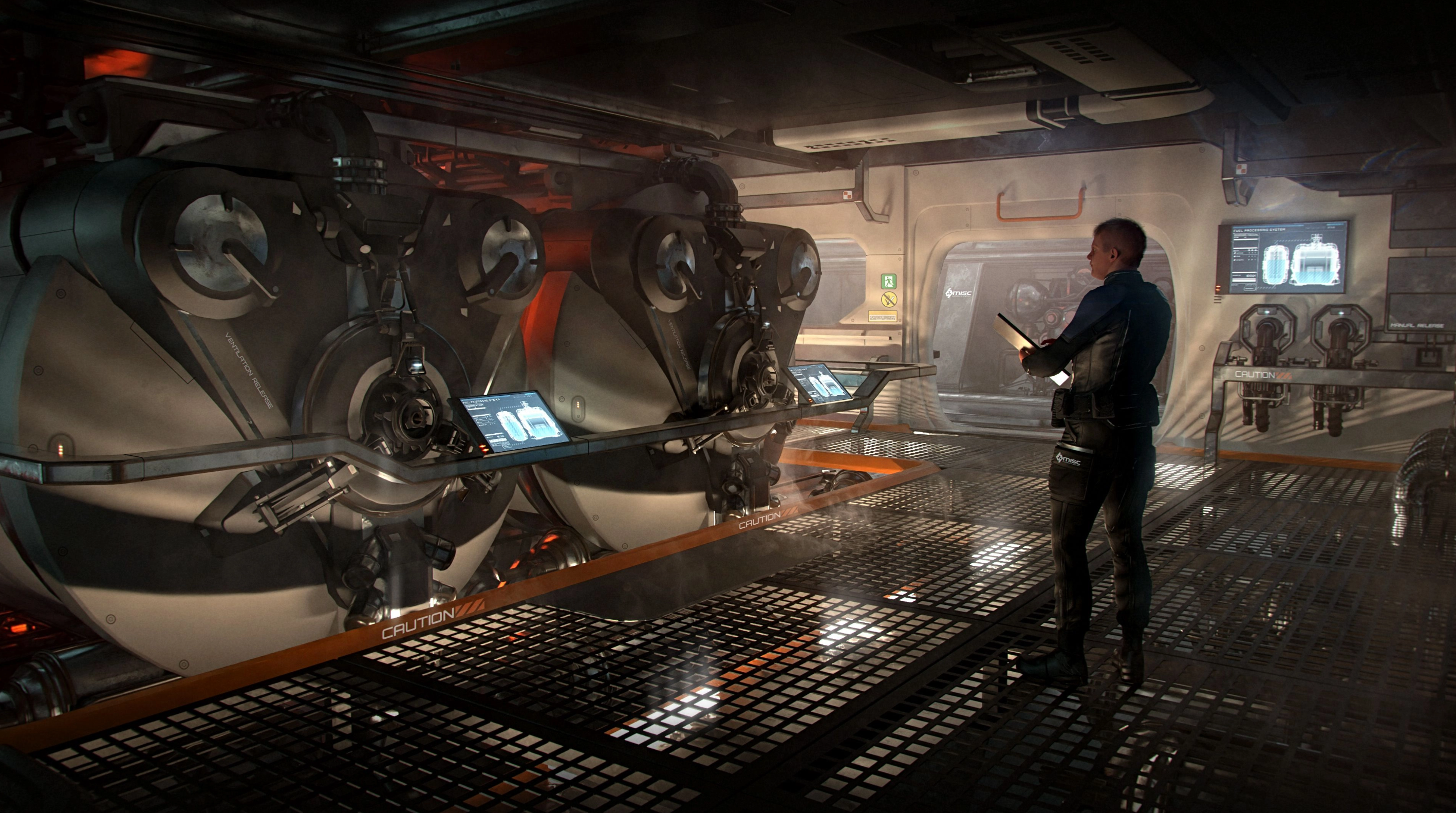
Inside Star Citizen | Engineering Talkin’ with ThorstenIt’s finally here. Fire. Heroics. Occasional Component Maintenance. All these and more are waiting for you when Engineering makes its way to the ‘verse in the upcoming Alpha 4.5
Star Citizen Alpha 4.5 Engineering System |
| Phase | Core Actions | Tools / UI | Scaling & Impact |
|---|---|---|---|
| Preparation (5–10 min) | Stock fuses, RMC canisters, extinguishers, spare components & filters Set power presets | Vendors, Vehicle Loadout Manager, Aesop UI (shareable presets) | Capital ships pre-load dozens of spares |
| Power Management | Balance finite power budget Prioritize & divert Relays degrade if fuses are depleted | Engineering stations, MFDs, 3D color-coded holograms (Green >50%, Yellow <50%, Red <20%) | No hard shutdowns — graceful degradation |
| Damage & Repair | RMC-beam repair (2–3× faster with team) Mid-flight swap of size 1–2 components Track wear & distortion | Multi-tool + RMC ammo Physical component bays | Quantum drives currently unrepairable in flight |
| Hazards – Fires | Fires from energy hits, overheating, or malfunctions Spread smoke & destroy components | Extinguishers (multi-player stacks faster + recharge racks) Daisy-chain doors to vent atmosphere | Emergent multicrew chaos — clutch moments |
| Armor (new in 4.5) | Energy weapons penetrate 1.4× better than ballistics Cone AoE to internals | Reticle pips & thickness readouts | Capitals tank initial rushes while engineers work |
RUIN Fleet Impact – We Need Hundreds of Engineers
With 15+ Idris, 15+ Polaris, multiple Javelins and dozens of Hammerheads, RUIN must execute the largest engineering expansion in org history.
| Fighters | 0 dedicated engineers (pilot MFD only) |
| Medium ships (Cutlass, Valkyrie, etc.) | 1–2 engineers |
| Large multicrew | 3–5 engineers |
| Polaris (12 total crew) | 3–4 dedicated |
| Hammerhead | 4–6 engineers |
| Idris frigate | 8–12 engineers across decks |
| Javelin destroyer | 10–20 engineers + chief coordinator |
| Full fleet deployment | 100–300 engineers required |
Training Pipeline (4–6 weeks)
- Week 1 – Solo basics, MFD repairs, extinguisher drills
- Weeks 2–3 – Multicrew mediums, relay & fuse swaps
- Weeks 4–6 – Capital mastery in live PTU fleets, comms discipline (“Fire Deck 3!”)
- Ongoing – Wear management, armor reads, custom overclock presets
Mentorship ratio 1 veteran : 3 recruits | Target 80% certification measured by operational uptime.
PvP Revolution
Engineering ends the solo-capital era overnight. An uncrewed Idris or Polaris will overheat, catch fire, and lose power in minutes. A fully staffed capital becomes near-unkillable:
- Fights last 3–5× longer
- Mid-combat component swaps and fuse hot-swaps keep full power output
- Fire teams extinguish in seconds instead of minutes
- Armor soaks the alpha strike while engineers rebuild health pools
Result: RUIN fleet lines become unbreakable. Hammerheads eat torpedo salvos and keep shooting. Polaris outlast Idris hunters. Massed capitals simply grind enemies into scrap through infinite sustain.
Call to Action – Become Part of the Machine
RUIN is recruiting engineers right now. Jump into PTU with us, earn your place on an Idris or Javelin, and help us engineer the ruin of our rivals.
Star Citizen’s Alpha 4.5 engineering system, now fully accessible in the All Backers Public Test Universe as of build 4.5.0-PTU.10869259 on December 6, 2025, marks a monumental evolution after years of teases, tech previews, and Inside Star Citizen deep dives—finally delivering a cohesive gameplay loop that transforms ships from fragile hulls into living, breathing machines demanding active stewardship. Gone is the era of passive health bars ticking inexorably to zero; in its place, a proactive cycle of preparation, monitoring, and heroic intervention emphasizes extending ship lifetimes rather than punishing players with constant misery, as Thorsten “Torston” developer lead astutely pivoted during recent PTU iterations. Pre-flight rituals now feel essential and tactile: scouring spaceport vendors for fuses, RMC canisters, spare components, and extinguishers before configuring shareable Aesop power presets that prioritize shields for defensive ops or weapons for aggressive pushes, a five-to-ten-minute investment that pays dividends in sustained combat viability across all ~110 flyable ships.
In-flight, the system’s brilliance shines through its layered UI and physicality, where engineering consoles and multi-function displays (MFDs) project color-coded 3D holograms of components—power plants, coolers, shields, quantum drives, propulsion, life support, and even doors—flashing green above 50% health, yellow down to 20%, and crimson below, demanding constant vigilance over a finite power budget mediated by capacitors for burst allocations and relays that degrade capacity if fuses blow without replacement. Damage manifests gradually, with distortion filling shutdown pools and wear-and-tear accumulating for station-side overhauls, but the real-time response loop elevates tension: multi-tool RMC beams mend breached parts at double or triple speed in coordinated teams, while size 1-2 components demand physical swaps from onboard storage mid-dogfight, turning potential mission-enders into recoverable setbacks.
Fires emerge as the chaotic crown jewel, ignited by energy weapon penetrations (1.4x more effective than ballistics via cone AoE), overheating from cooler mismanagement, or wear-induced malfunctions, propagating smoke that blinds bridges and risks catastrophic explosions now tuned to a 20% critical chance in recent patches, only quelled by stacked extinguishers from recharge racks or clever daisy-chaining of doors to vent atmospheres—emergent “hero moments” that reward multicrew communication like barked “Fire Deck 3!” macros.
For solo pilots, engineering proves surprisingly accessible yet transformative, relying on pilot-seat MFDs for quick RMC patches that let battered fighters limp home after scraps, extending operational lifetimes without overwhelming the lone wolf experience, though quantum drives remain frustratingly unrepairable in-flight due to persistent bugs. Medium ships like the Cutlass or Valkyrie unlock interiors for 1-2 dedicated engineers handling relay restocks and fire squads, while capitals—Idris frigates, Polaris corvettes, Javelin destroyers—explode into symphony of roles with 5-15+ crew coordinating across decks, where a chief engineer diverts capacitors for shield spikes before weapon overclocks, fundamentally invalidating solo-cap flights as uncrewed behemoths overheat, ignite, and depower in minutes. PTU testing, from Wave 1 on December 1 through today’s all-backer access, reveals a system brimming with potential but raw around the edges: fires in unreachable spots, non-functional alarms for all but one crewmember, cooler inefficacy on ships like the Perseus, and exploits like powerclipping reactors highlight the 200+ ship integration challenges, yet iterative patches—faster repairs, fuse durability buffs, thruster hardening—demonstrate responsive dev work ahead of the mid-December live target around the 20th.
In PvP, engineering revolutionizes dynamics by ballooning time-to-kill (TTK) 3-5x for competent crews, where armor’s penetration mechanics soak alpha strikes on thick-hulled capitals, buying precious seconds for teams to extinguish, replate, and hot-swap fuses to reclaim full output, turning attrition grinds into org supremacy showcases—Hammerheads tanking torpedo salvos, Polaris outlasting hunters via cooler prioritization—while neglectful zergs cascade into self-inflicted meltdowns. PvE benefits similarly, with extended hauls surviving ambushes through on-the-fly repairs, though current weapon balance critiques—size 3 lasers insufficient against armor—underscore ongoing rebalances, including 74% shield/weapon damage reductions offset by these new layers.
Player impressions split predictably: enthusiasts hail “super cool” fire propagation and heroics for injecting simulation depth, while skeptics decry rushed holiday deployment risking balance Armageddon, flip-flopping stats eroding test confidence, and repetitive tedium if proactive choices lack impact. Ultimately, Alpha 4.5’s engineering cements Star Citizen as the pinnacle space sim, where mastery yields unbreakable fleets and emergent narratives, but its live success hinges on post-PTU polish—tuning wear for sustainability, exorcising bugs, and ensuring repairs outpace damage in balanced skirmishes. The design doc’s vision of scalable, fun extension over annoyance holds promise, and with Nyx looming, this isn’t the end but the ignition of deeper systems; for now, PTU testers are the vanguard, forging a ‘verse where every spark could spell ruin or redemption.